
Synthetic communities
Control of synthetic communities
Extend the subpopulation-network view from one species to many, and a microbial community becomes something to design: distinct strains held in complementary metabolic niches, kept cooperative and stable rather than left to compete or collapse.
Extending the subpopulation framework to multi-species communities
The framework developed for clonal populations, in which interacting subpopulations form a structured network whose collective dynamics determine population-level function, extends naturally to synthetic communities composed of distinct microbial species, or more broadly, of distinct cell types. In both cases, the fundamental object of interest is the same i.e., a network of interacting phenotypic entities whose composition, dynamics, and intercellular exchanges govern collective behaviour.
Niche engineering and the risk of metabolic reversion
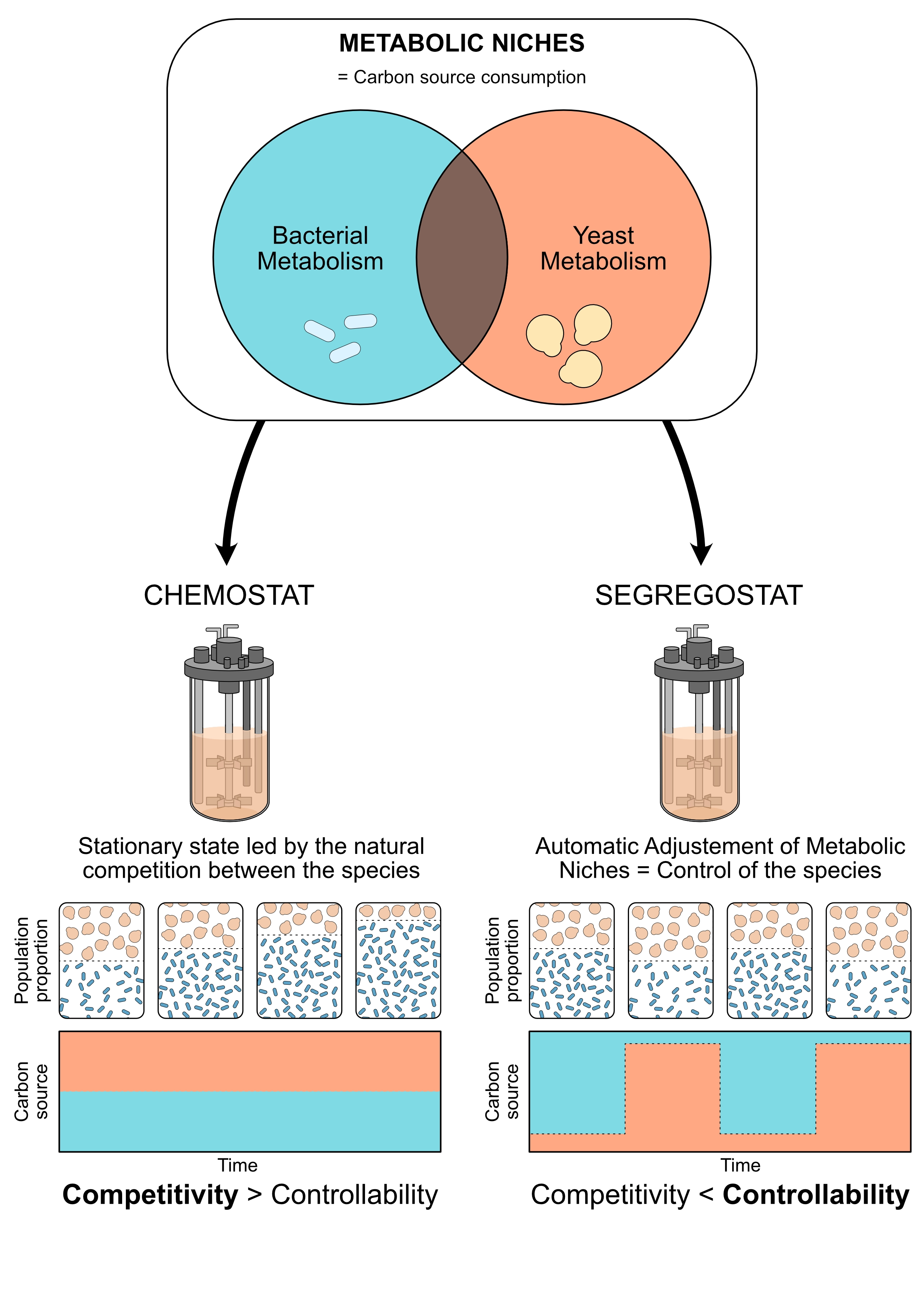
A central challenge in synthetic community design is the control of metabolic niches i.e., the functional roles that individual strains or cell types occupy within the community's metabolic landscape. Unlike natural ecosystems shaped by long evolutionary history, engineered communities must be deliberately structured so that each member contributes to a defined metabolic function without outcompeting or displacing others. We approach this through the lens of niche engineering: identifying the metabolic states that define each community member's functional identity, and designing process conditions (substrate feeding strategies, dilution rate, spatial organisation) that stabilise coexistence by maintaining complementary rather than competing niches. A related and underappreciated phenomenon is metabolic reversion, whereby community members under competitive or resource stress revert from a specialised, cooperative metabolic state toward a more generalist, self-sufficient phenotype. This reversion undermines the division of labour that makes synthetic communities functionally superior to monocultures, and its prevention requires monitoring and control strategies that are sensitive to the metabolic state of individual community members.
Stabilising communities through metapopulation design
Stabilising synthetic communities against compositional drift, invasion, and collapse represents a further engineering challenge that we address through metapopulation design. By distributing a community across interconnected cultivation vessels with controlled cell exchange, it becomes possible to exploit spatial structure as a stabilising mechanism. Local perturbations (competitive exclusion, environmental stress, phenotypic reversion) that would destabilise a well-mixed community can be buffered by phenotypic and demographic fluxes from neighbouring compartments. This architecture converts the community into a coupled metapopulation in which diversity and function are maintained not by suppressing competitive dynamics but by managing them across space and time. The same scaling laws and dimensionality reduction principles developed for clonal SP networks apply here since the interacting species or strains of a synthetic community define a low-dimensional compositional manifold, and collective community performance follows scaling relationships with community size and interaction structure that can be exploited for rational design and scale translation.