
Inference & biocomputing
Subpopulation networks as a framework for biological inference and biocomputing
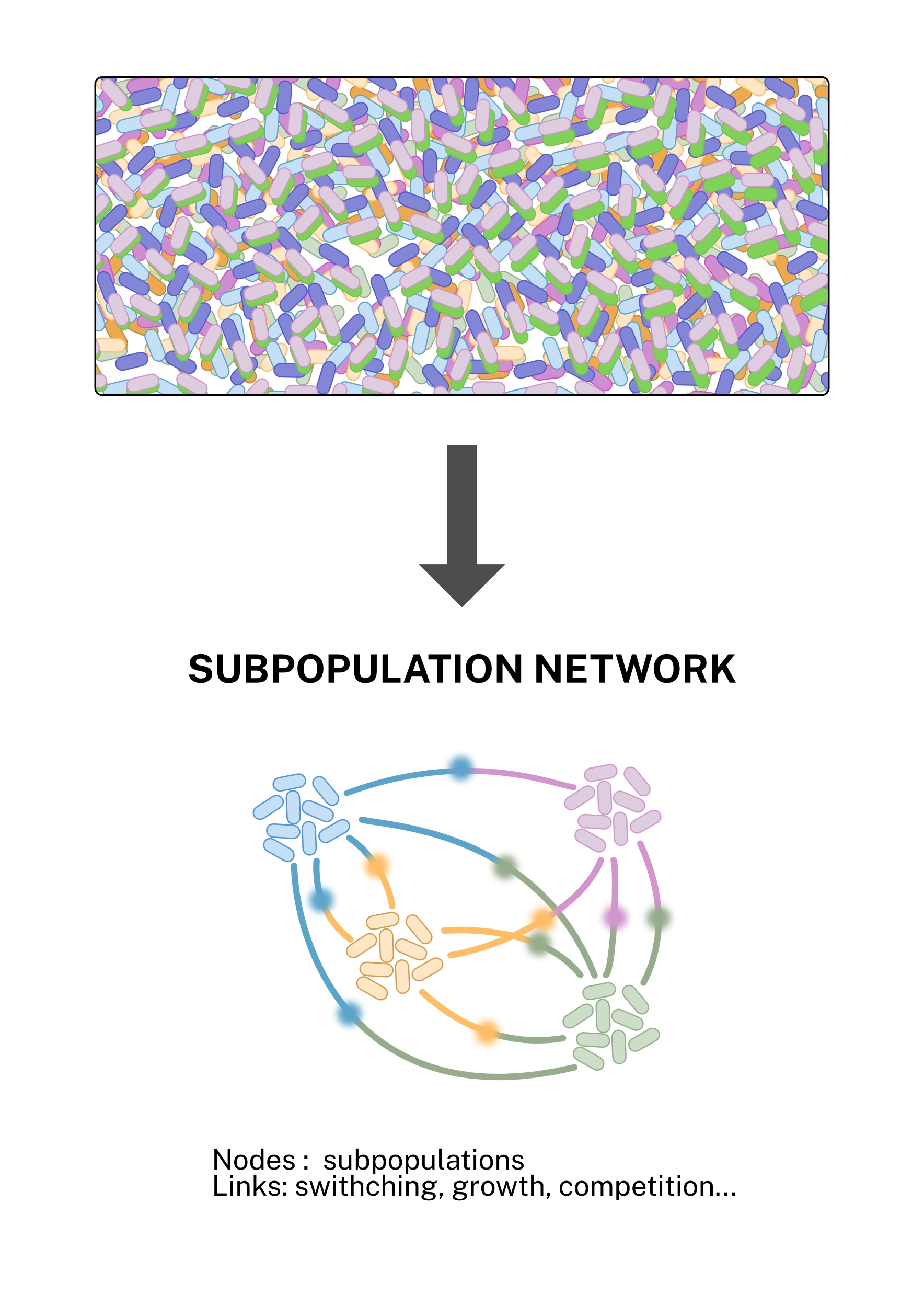
Seen as a network of interacting subpopulations rather than a crowd of individual cells, a microbial population becomes both easier to model in real time and richer to read, and it can even be used to compute.
From individual cells to a network of subpopulations
A microbial population structured into interacting subpopulations (SPs) can be described, modelled, and exploited at the level of the network rather than the individual cell. This shift in perspective has both practical and conceptual consequences. From a modelling standpoint, representing a population through a limited number of interacting SPs yields a dramatic reduction in dimensionality compared to tracking stochastic biomolecular processes across thousands of individual cells. This low-dimensional representation makes real-time inference tractable and opens the door to SP-aware monitoring and control strategies for autonomous biomanufacturing systems, where the population structure itself becomes the observable that drives process decisions.
Subpopulation networks as living computers
From a biological standpoint, SP networks carry information that bulk measurements simply cannot resolve. Our results show that the dynamics of interacting SPs are more informative than population averages for deciphering complex biological processes e.g., plasmid replication, stress resistance, and protein synthesis and secretion. The structured diversity of a population encodes its history and physiological state in a form that can be read out quantitatively. This last point connects to a broader and more radical idea i.e., SP networks are natural reservoir computing architectures. The population encodes environmental inputs into its structure over time, and that structure can be interrogated to perform inference tasks, effectively turning a living microbial population into a biological computer. This positions SP networks not only as objects of study, but as functional substrates for biocomputing.