
Population dynamics
Collective behaviour in microbial populations and the emergence of subpopulations
Even genetically identical cells don't all behave the same way, and that diversity isn't just random noise. It emerges from how cells time their gene circuits, allocate resources, and respond to their environment, driving distinct subpopulations that interact to produce collective behaviour.
Spontaneous emergence of subpopulations
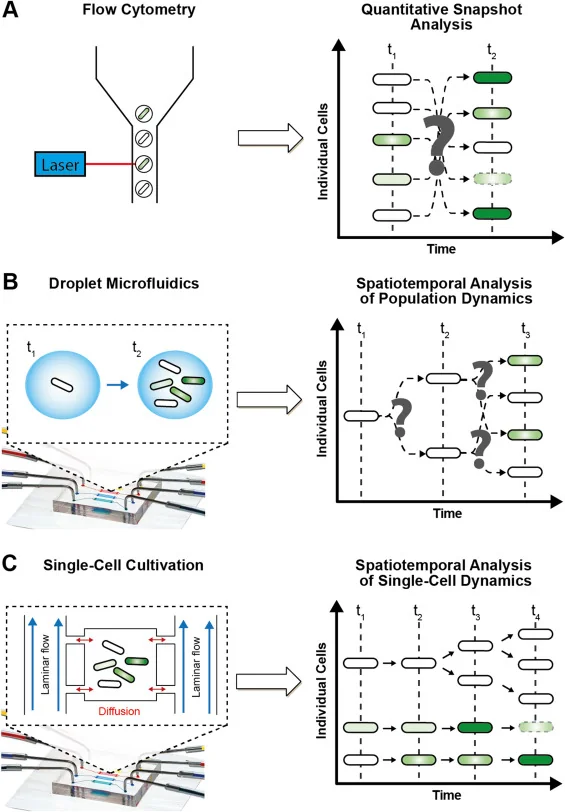
Clonal microbial populations are not homogeneous and spontaneously self-organise into phenotypically distinct subpopulations (SPs, typically detected based on fluorescent reporters) whose interactions shape the collective behaviour of the whole. Understanding how this structured diversity arises and gives rise to complex population-level dynamics is a central question in microbial biophysics.
Switching cost, not noise, drives fixation
Beyond classical stochastic switching, we showed that SPs behave as competing ecological species, with fixation dynamics governed not by random biological noise alone but by the timing of gene circuit activation and its underlying metabolic cost (switching cost). Specifically, heterogeneity in the timing of gene expression, amplified by environmental fluctuations, can drive phenotypic escape (i.e., allowing cells the escape high expression level correlated with high burden) and the stable fixation of distinct SPs.
Resource allocation as a biophysical constraint
A key finding of our group is that this timing is regulated by resource allocation i.e., the cellular cost of switching between phenotypic states acts as a biophysical constraint shaping which SPs emerge, at what frequency, and under which conditions. At the population level, these mechanisms can generate collective dynamics (bistability, oscillations, hysteresis…) that are not determined by gene network topology alone, but emerge from the coupling between subpopulation switching kinetics, resource allocation, and environmental feedback.