
Bioprocess control
Bioprocess digitalisation and control: from population structure to self-regulating, scalable processes
Treat a microbial population not as a black box but as a structure to be read and steered, and the bioprocess can begin to regulate itself: catching instability before it shows, and carrying what works from the laboratory bench to industrial scale.
Beyond black box bioprocesses
Classical bioprocess design treats the microbial population as a black box, optimising bulk variables (titre, yield, productivity) without accounting for the internal structure that actually governs performance. We take the opposite view: population structure, described through its interacting subpopulations, is both the primary object of monitoring and the natural handle for control.
The Segregostat: from early warning to self-regulation
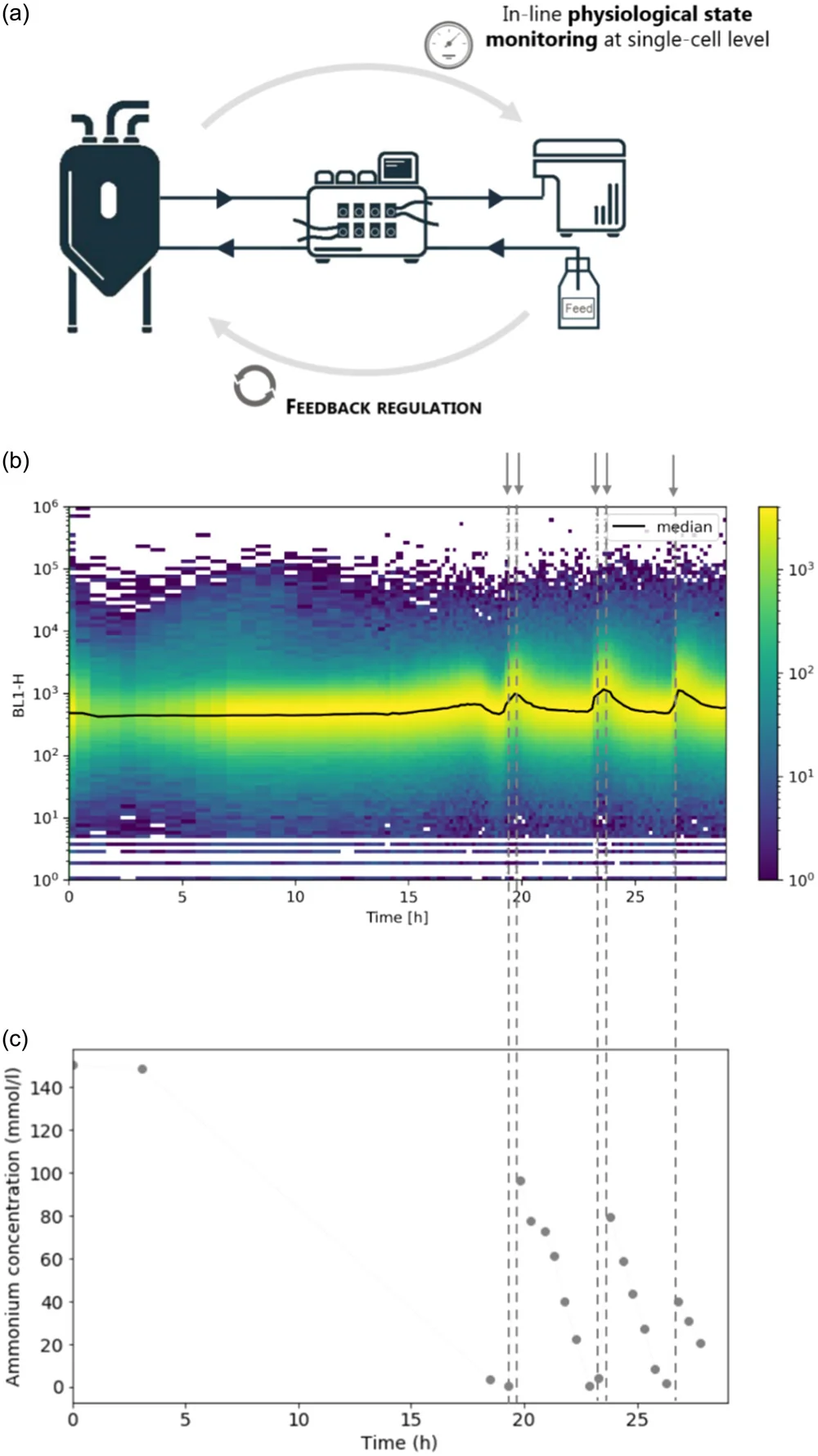
This perspective enables a new class of self-regulating bioprocesses. In continuous cultivation, the SP network of a microbial population encodes its physiological state and its history of environmental exposure in a form that is both measurable, via real-time flow cytometry, and actionable. The emergence or expansion of specific SPs can serve as early-warning indicators of impending process instability, shifting control from reactive correction to anticipatory intervention. We have demonstrated this principle using the Segregostat, a platform that couples single-cell resolved population monitoring to dynamic process actuation, converting population structure into a feedback signal that stabilises continuous operation under otherwise destabilising conditions. Extending this to networked cultivation vessels, where continuous cell exchange between compartments redistributes phenotypic states and buffers local fitness costs, introduces a meta-population architecture that further enhances process robustness and opens the door to fully autonomous, structure-aware bioprocesses.
Rational scale-up through subpopulation descriptors
Scale-up and scale-down represent a persistent and largely unsolved challenge in bioprocess engineering. Translating process performance from laboratory to industrial scale fails, in large part, because the environmental heterogeneity that emerges at large scale reshapes population structure in ways that bulk models cannot anticipate. The low-dimensional representation afforded by SP networks offers a principled solution. Rather than attempting to match all physicochemical gradients across scales, one can identify the SP-level descriptors that remain conserved despite scale-dependent environmental heterogeneity. Combined with scaling laws relating collective population performance to SP network organisation, this framework enables rational scale translation. This involves predicting how process outputs will change with scale from a compact set of population-level variables and designing scale-down models that faithfully reproduce the SP dynamics of industrial conditions at laboratory scale.